

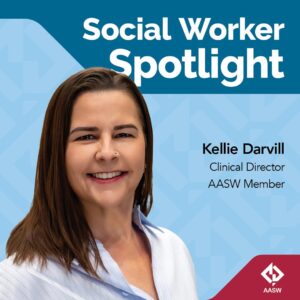
 For Kellie Darvill, social work wasn’t a childhood dream, but a path discovered later in life, shaped by lived experience, reflection, and a strong sense of justice. In her thirties, after years of self-doubt about her ability to study or change direction, a chance moment became a turning point. While working as a waitress, Kellie overheard a conversation that reduced people’s worth to categories and status, implying that some lives mattered more than others.
“That conversation lit a fire in my belly,” she says.
In that moment, Kellie made a promise to stand alongside people whose voices are often dismissed and to challenge the systems that create inequality. Stepping beyond her comfort zone, she found that social work was not just a profession, but a way of walking beside others with dignity, purpose, and respect.
Kellie began her career as a youth worker in residential care within the out-of-home care system. The experience was intense and demanding, but it laid the foundations she continues to rely on today. Her student placements further shaped her practice, particularly through the guidance of a field educator who became a lifelong mentor and remains her clinical supervisor.
After graduating, Kellie worked in the family and domestic violence sector, supporting women and children experiencing violence and facilitating men’s behaviour change programs. These roles deepened her understanding of power, injustice, and humility, before she moved across government and non-government roles in child protection and out-of-home care, where adaptability and creativity were essential.
Over time, Kellie felt the need to reclaim her social work identity and move away from restrictive systems toward practice that felt authentic and relational. That journey led her back to the NSW South Coast, where she founded Expressive Mind Therapy, a small multidisciplinary practice built on collaboration, inclusion, and dignity. The practice brings together speech pathology, social work, behaviour support, and counselling, helping to bridge service gaps and support people who might otherwise fall through them.
Regional practice is where Kellie says her heart truly lies. She is passionate about challenging the idea that rural and regional communities should accept reduced access to services or lower-quality care simply because of where they live.
“At its core, the greatest issue is inequality — the idea that smaller communities somehow matter less,” she says.
For Kellie, regional social work is profoundly human. It is built on long-term relationships, trust, and connection that extends well beyond service plans. Working in a small regional practice is both challenging and rewarding, requiring creativity, flexibility, and persistence in the face of limited resources and slow-moving systems. Being part of a close-knit team allows for genuine relationships and responsive, person-centred support.
One of the most defining moments of Kellie’s career occurred while she was still a student, supporting a woman applying for an Apprehended Violence Order. When a police officer questioned whether issuing the order was appropriate because the violence had not been reported quickly enough, Kellie found the courage to challenge the response.
“Your posters say you stand against domestic violence — none mention a time limit,” she said.
The order was granted, and the experience cemented advocacy as a core part of Kellie’s practice. She continues to see advocacy not as paperwork, but as people work, grounded in courage and accountability.
Kellie reflects honestly on the challenges of social work, particularly the sense of being undervalued despite the emotional labour and responsibility the role carries. Much of the work happens quietly behind the scenes, yet the rewards are deeply meaningful. She speaks of the privilege of being trusted, of walking alongside people in their most vulnerable moments, and of witnessing small but powerful steps toward each person’s own version of success.
Her work has included trauma-responsive support in local schools, advocacy for families navigating the NDIS during end-of-life care, and ongoing support for people experiencing trauma, stigma, and marginalisation. Each story has shaped her as a practitioner and reinforced her belief that understanding must always come before judgement.
Reflective practice and supervision remain central to Kellie’s work. She sees them as essential to ethical practice, providing space to pause, reflect, and remain grounded in values in a profession that asks so much of its practitioners.
Looking ahead, Kellie is committed to continuing to build a practice that reflects the true heart of social work: ethical, creative, trauma-informed, and grounded in community. She is passionate about mentoring emerging social workers, strengthening professional identity, and challenging the notion that high-quality practice cannot thrive in regional settings. For Kellie, social work is not about fixing people, but about walking beside them, embracing complexity, and creating quiet, lasting change within communities.