

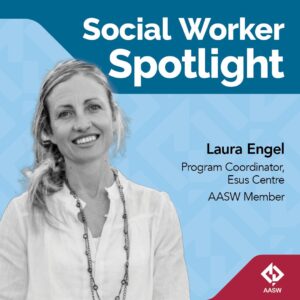
Laura Engel’s career exemplifies the values at the heart of the Australian Association of Social Workers: respect for persons, social justice, and professional integrity. With a background in mental health social work and psychotherapy, Laura advocates for a profession that honours the complexity of people’s lives and the systems they navigate.
Her practice spans hospital settings, private therapy, group work, academia, and outdoor health. She has contributed to the development of The Esus Centre, an integrative eating disorder clinic in Western Australia, where she co-designed a day program for people experiencing binge eating disorder. Laura views this as an act of advocacy in itself, challenging the systemic neglect of this widely misunderstood condition.
“Many of the people I work with have struggled to be seen or understood within existing systems,” she says. “I wanted to create a space where their experiences are met with dignity and care.”
Laura’s work reflects a commitment to expanding the reach of social work beyond traditional models. Her grief-informed walking therapy project, Trail Tracing, developed in partnership with The Grief Centre of WA, offers a nature-based approach to bereavement support. Rooted in eco-social work principles and grounded in cultural respect, the program is a powerful example of how therapeutic innovation can emerge from personal and collective healing.
Whether supporting clients, supervising students, or writing about social work’s evolving role in mental health, Laura advocates for broader recognition of the profession’s capacity to deliver trauma-informed, relational, and evidence-based care.
“I hope to expand understandings of social work beyond service coordination or case management,” she says. “We are relational, reflective, and deeply skilled in psychological care. That should be visible.”
Her ongoing dedication to supervision, interdisciplinary collaboration and reflective practice demonstrates a lived commitment to AASW’s ethical framework. In a field often constrained by crisis responses and limited funding, Laura’s work is a reminder that advocacy is not only political—it is also deeply personal, relational and embedded in everyday practice.