

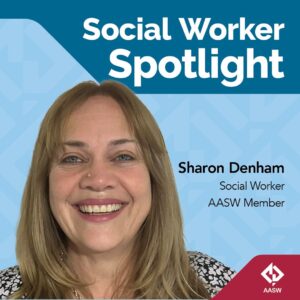
 For Sharon Denham, social work was never just a job. It was a natural extension of who she is. “I feel I’ve always been a social worker; I just happened across a career path that aligned with who I am and my values,” she reflects.
Like many in the profession, Sharon’s pathway into social work was not linear. She came to the field after working in several different careers and initially imagined herself working in a women’s refuge, convinced she would avoid child focused practice. That assumption did not last long. “Children are brutally honest and I love that,” she says. What began as work in out of home care became the foundation for a career long commitment to children, families, and one area of practice that would shape her professional purpose: Fetal Alcohol Spectrum Disorder (FASD).
Sharon’s first direct encounter with FASD occurred early in her out of home care work, when she supported a foster carer raising a young child with suspected FASD. At the time, Sharon had limited knowledge of the condition. She quickly discovered how difficult it was for families to access assessment, diagnosis, and understanding, particularly in rural areas. A specialist appointment that dismissed the child’s presentation left a lasting impression on her and highlighted a significant gap between current research and real world practice.
Living and working in a rural community, Sharon saw firsthand how systemic barriers such as long waitlists, workforce shortages, travel costs, and fragmented services prevented children and carers from receiving timely support. As her understanding of FASD grew, so did her awareness of how many children were living without diagnosis or appropriate accommodations. In out of home care, this often resulted in misunderstood behaviours, school exclusion, and placement breakdowns.
“I identified very quickly that there was a lack of services in rural areas,” Sharon explains. “I came to believe that I could do better work in that space, working just with FASD.”
Today, Sharon’s practice is focused on providing accessible, affordable FASD assessments and supports for children, young people, and their carers. Her work bridges the gap between diagnosis and lived experience, translating complex information into practical, FASD informed strategies that families and educators can use in everyday life. She is particularly passionate about early intervention and believes it offers the greatest opportunity for improved lifelong outcomes.
A key part of Sharon’s work involves education. This includes challenging misinformation about alcohol use during pregnancy, increasing understanding of how FASD impacts behaviour and learning, and supporting schools to adapt environments rather than expecting children to conform. She regularly encounters educators who recognise FASD in theory but struggle to apply effective strategies in practice. Sharon sees her role as helping people move from awareness to action.
Her current setting is not without frustration. A lack of local services and inconsistent understanding of FASD, even among medical professionals, continues to create barriers. Yet these challenges have only strengthened her resolve. “It’s been very frustrating, but those frustrations have just made me more passionate,” she says.
The rewards of rural social work are deeply personal. In a close knit community, Sharon sees the long term impact of her work every day through conversations in the street, shared updates, and visible progress. She speaks movingly about the relief families feel when they finally have language to understand their experiences. “That’s the most rewarding part of my work, seeing the relief people feel when they have a better understanding of what’s happening for them.”
Sharon is also a strong advocate for reflective practice and supervision, particularly as one of few social workers working in the FASD assessment space. Supervision has supported her to navigate professional isolation, refine her practice, and remain grounded in trauma informed, ethical work. She is deeply committed to representing social work with pride in multidisciplinary environments and challenging assumptions about what social workers can and should do.
Beyond her professional role, Sharon’s connection to community shapes her practice. Living in a low socioeconomic area with a high Aboriginal and Torres Strait Islander population, she emphasises the importance of genuineness, empathy, and understanding people in the context of their lived experiences. She also draws strength from the resilience she sees around her, particularly following floods, bushfires, and collective trauma.
Looking to the future, Sharon is optimistic. She hopes to see social workers more recognised in the FASD assessment and diagnostic space, expanded access to services, and continued efforts to reduce stigma. More broadly, she believes social work will continue to evolve into increasingly diverse and clinical roles, while remaining grounded in advocacy and partnership.
“Social work is a great profession,” Sharon says. “There are so many paths to choose from. It can be as simple or as complex as you want it to be, and that’s what I love about it.”