

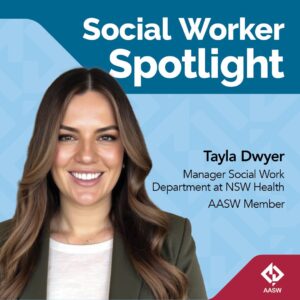
 Tayla Dwyer is a social worker whose practice stretches across vast distances. As Manager of Social Work in the Far West of New South Wales, she leads services covering more than 195,000 square kilometres, supporting communities where geography shapes every aspect of care.
“I was drawn to social work because I’ve always felt compelled to sit with people in their most vulnerable moments,” Tayla says. Her early experiences as a victim survivor within statutory systems and her work in Aboriginal health shaped her commitment to justice and culturally safe practice. “Social work gave me the clinical and ethical framework to turn that commitment into action.”
After beginning her career in education, Tayla recognised that many challenges facing children were rooted in social determinants rather than learning difficulties. She completed a Master of Social Work and moved into roles across child protection, child and adolescent mental health, psycho oncology, palliative care, hospital social work, disability navigation and violence, abuse and neglect services. Over time, she stepped into leadership in one of the most remote regions of the state.
“Rural and remote practice demands adaptability,” she explains. “We respond to crises in isolation, often with limited referral pathways and significant workforce shortages.” Long travel distances, sole clinician roles and service gaps are everyday realities. “Life expectancy in rural and remote Australia is lower than in metropolitan areas. The reasons are complex and layered, and you feel that every day in practice.”
Despite the challenges, Tayla speaks passionately about the rewards. “You genuinely see the impact of your work here. When you help someone access NDIS supports, navigate guardianship processes, or stabilise after acute mental health distress, there may be no one else available to step in.” She describes social workers in remote communities as bridges between people and systems. “Every risk assessment, behaviour plan and safety plan contributes to the wellbeing of the whole community.”
One experience stands out. Tayla and a junior clinician supported a person with Huntington’s Disease who was repeatedly presenting to hospital in distress. Through comprehensive assessment, behaviour support planning and collaboration with family and virtual specialists, they reduced restrictive practices and supported a safe discharge. “The partner told us it was the first time they felt genuinely heard,” Tayla recalls. “That is the power of holistic, person centred social work.”
Supervision and reflective practice are essential safeguards in such isolated settings. “Working in high risk environments requires constant self awareness,” she says. “Reflection strengthens clinical reasoning and protects both practitioners and communities.”
Tayla believes more social workers should experience rural and remote practice. “It builds resilience, leadership and creativity,” she says. “It also deepens your understanding of the additional disadvantages faced by people living far from metropolitan centres.” Her hope for the profession includes greater investment in rural services and stronger recognition of social work as a clinical discipline. “Geography should never determine the quality of care a person receives,” she says.