

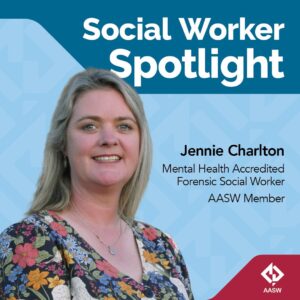
 Jennie Charlton is a social worker whose career has been shaped by a deep commitment to ending sexual violence and strengthening the systems that respond to it. Across forensic mental health, crisis response, education and private practice, her work is anchored in trauma informed, relational approaches that hold safety and accountability together.
“I became a social worker because I have always believed that fairness should not depend on luck,” Jennie reflects. “Even as a child, I felt a strong sense that injustice should never be accepted as inevitable.” That belief has guided more than two decades of practice across child protection, corrections, disability, fostering, mental health and sexual assault services in both the UK and Australia.
Jennie currently works as Director of JC Assessments and Training, Senior Social Worker at Owenia House within SA Health’s Forensic Mental Health Service, NGO Coordinator with the Northern Adelaide Local Health Network, On Call Crisis Response Worker with Yarrow Place Rape and Sexual Assault Service, and Casual Topic Coordinator in the Master of Social Work program at Flinders University. Each role informs the other. “Whether I am sitting with a victim survivor in crisis, completing a forensic assessment, or teaching a class of future social workers, my focus is the same,” she says. “We must build responses that are humane, evidence informed, and grounded in lived experience.”
Her work in sexual violence spans crisis intervention, therapeutic counselling, forensic assessment and systems reform. She describes her approach as centred on dignity and voice. “For victim survivors, the priority is safety, consent and restoring a sense of control. For those who have caused harm, it is about accountability and understanding the impact of their behaviour. Both require a trauma informed lens.”
Jennie believes meaningful prevention requires collaboration across disciplines. “Sexual violence does not sit neatly in one service or sector,” she explains. “We need connection between health, justice, education and community services if we are serious about change.” In her forensic work, she has seen how early trauma, poverty and exclusion intersect with offending behaviour. “Holding compassion and accountability together is not soft. It is rigorous and it is necessary.”
Her leadership within the AASW South Australia Branch has also been central to her career. As former Vice President and long standing Convenor of the Social Justice Committee, Jennie has advocated for stronger policy responses, cultural accountability and greater visibility of social work in public debate. She was closely involved in implementing the Branch’s first Reconciliation Action Plan in partnership with Kaurna Elder Aunty Shirley Young. “Leadership in social work is about integrity and relationships,” Jennie says. “It is about standing up when systems fall short and working collectively to do better.”
Reflective supervision remains essential in such complex work. “Good supervision keeps me grounded and accountable,” she shares. “It creates space to process the emotional weight of sexual violence work so that I can continue to practice ethically and safely.”
Looking ahead, Jennie hopes to continue strengthening trauma informed practice across South Australia and nationally. “If we are not part of the solution, we are part of the problem,” she says. “Social workers have a responsibility to shape systems that prevent harm, promote recovery, and centre the voices of those most affected.”