

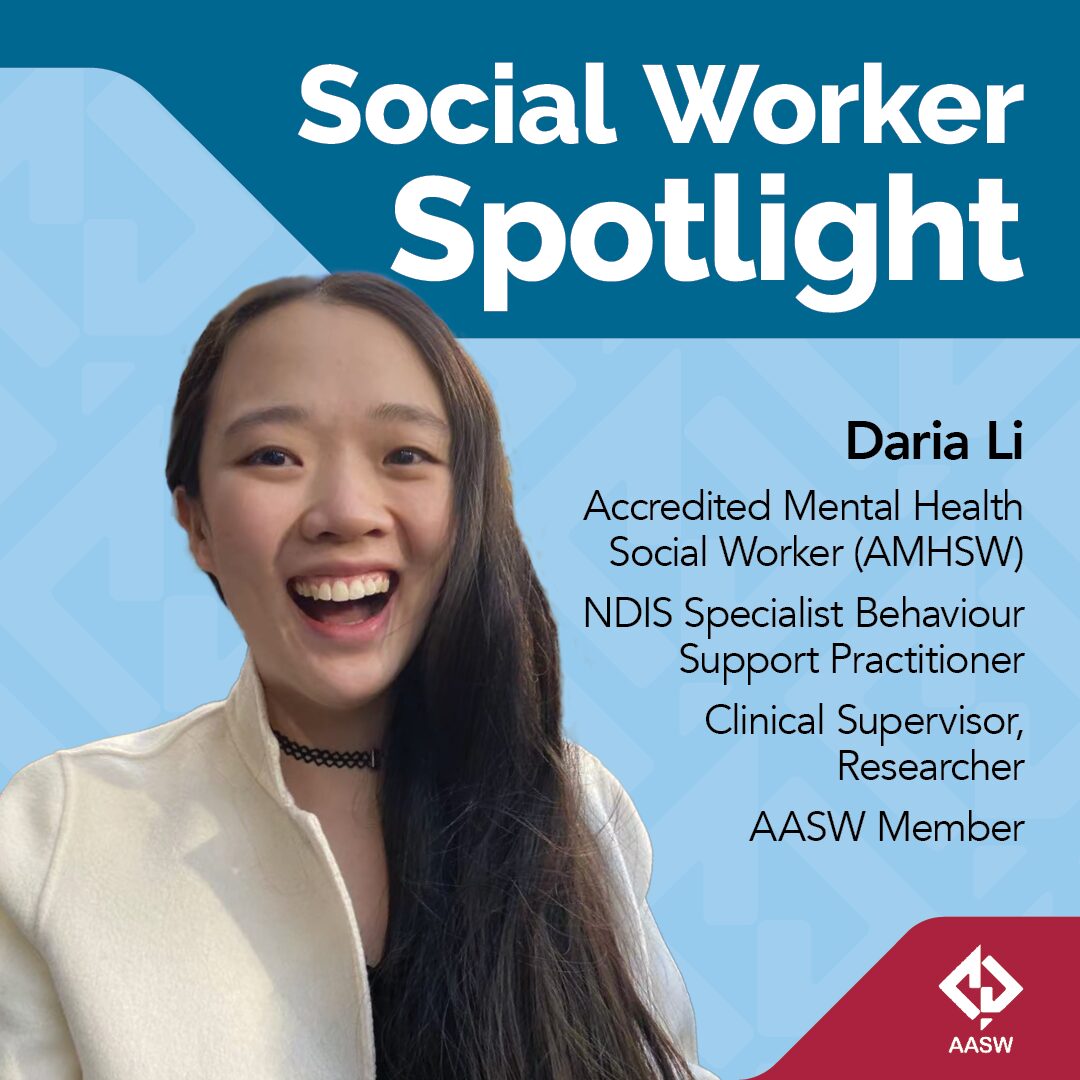
 Daria (Xuejiao) Li did not set out to become a social worker in the traditional sense. Long before she discovered the profession, she was already navigating the experiences that would later shape her career and her approach to practice.
“I often say that I entered social work long before I ever knew the profession existed,” Daria says.
Growing up, Daria experienced childhood abuse, family violence, sexual assault, ADHD and what she now understands as complex post-traumatic stress disorder (C-PTSD). As a young culturally and linguistically diverse (CALD) migrant, she learned early what it meant to survive systems rather than be supported by them.
“Those years formed a kind of emotional literacy. I understood fear, fragmentation, dissociation and the quiet courage it takes simply to keep going.”
When she eventually discovered social work, it provided a framework that brought meaning to her lived experience.
“Social work became the first place where all those experiences finally made sense. It offered a way to transform pain into clarity, and survival into something that could help others feel less alone. I didn’t choose social work as much as I eventually recognised myself in it.”
Today, Daria is an Accredited Mental Health Social Worker (AMHSW), NDIS Specialist Behaviour Support Practitioner, clinical supervisor, researcher and founder of the Australia Association of CALD Mental Health Practitioners (ACMHP). Her work spans trauma-informed mental health practice, behaviour support, supervision, leadership and research translation.
Her professional journey has taken many turns. Beginning in frontline family violence services, she was often drawn to people whose behaviour others found difficult to understand.
“I recognised something in them – something familiar,” she says.
Over time, her work expanded into mental health, behaviour support and clinical supervision. A period of burnout became a turning point, prompting her to rethink how sustainable and ethical practice should look.
“I rebuilt my practice from the ground up with a focus on sustainability, reflective practice and trauma stewardship.”
That experience also inspired her to establish ACMHP, creating a professional community that values ethics, lived experience and humanity alongside technical expertise.
Daria describes her area of practice as existing at the intersection of trauma, psychology, culture and human rights.
“I work where trauma, psychology, culture and human rights meet – because that’s where people are most often misunderstood.”
Her lived experience and clinical training together inform a practice grounded in empathy and understanding. She is particularly passionate about supporting people who have been silenced, marginalised or misread by systems.
A significant part of Daria’s current work involves supervision, which she describes as one of the most meaningful aspects of her career.
“Supervision has become one of the most meaningful parts of my career. It’s a space where people can breathe, reflect and rediscover clarity – often after years of holding too much.”
She believes reflective practice is essential to ethical social work and mental health practice.
“For me, reflective practice is not optional – it’s the anchor of ethical mental health work.”
One story that stands out in her career involved supporting a practitioner working with an adult who had been labelled as “challenging” for much of their life. Through a trauma-informed lens that considered sensory experiences, human rights and emotional safety, the team developed a new understanding of the person’s behaviour.
“The team softened. The relationship shifted. And eventually, a restrictive practice in place for three decades was safely removed.”
For Daria, these moments demonstrate the transformative power of reflective, trauma-informed practice.
She has also contributed to broader conversations about trauma and justice, including providing expert witness evidence in an international legal case. Her role involved explaining the psychological impacts of prolonged coercive control, the neurobiology of fear and trauma responses that are often misunderstood.
“It reminded me that Australian mental health and social work frameworks can influence global conversations about justice, safety and victim understanding.”
Daria sees some of the biggest challenges facing the people she works with as complex trauma, cultural stigma and inequitable access to mental health support. She believes CALD communities are often particularly affected by silence, shame and a lack of culturally responsive services.
Her commitment to advocacy extends beyond direct practice. Through ACMHP, education, public speaking and research translation, she works to make mental health knowledge more accessible and to bring trauma-informed perspectives into public conversations.
As both a social worker and a person with lived experience, Daria believes social workers are often misunderstood.
“People sometimes think social workers are more resilient or immune than everyone else. Social work is meaningful – but it is also a job. Everything that happens in other professions – stress, ethical tension, burnout – happens here too.”
For those considering a career in mental health and trauma-informed practice, her advice is simple.
“Stay curious. Listen deeply. Don’t rush to label. Seek supervision early and consistently.”
Outside of work, Daria has found creative outlets through acting and expressive arts, including movement, sound and visual storytelling. She sees creativity as a way to process emotions, reconnect with herself and find beauty after difficult experiences.
Looking ahead, Daria hopes to continue strengthening trauma-informed mental health practice, expanding access to reflective supervision and contributing to policy and research that better recognise the realities of trauma and human rights.
She also believes the future of social work lies in deeper integration of trauma science, cultural humility and lived experience leadership.
“I believe social work will move toward deeper integration of trauma science, cultural humility, lived experience leadership and human-rights-centred practice. That’s the direction the world is moving – and the space where I feel most called to work.”
At its heart, Daria’s career is driven by a desire to help others feel understood and supported.
“The privilege of walking alongside people – clients, supervisees and families – at the most tender chapters of their lives is one of the greatest gifts of my career.”
Her story is a powerful reminder that lived experience, when combined with reflection, compassion and professional expertise, can become a force for healing, advocacy and lasting systems change.